Legend & origins
The evangelist, the martyrs' calendar, and the desert
Christian Egypt begins, by tradition, with a broken sandal strap. Mark the Evangelist landed at Alexandria around 42 AD and stopped at a cobbler to have his shoe mended. The cobbler was called Anianus. He became Mark's first convert, and later the second bishop of the city.
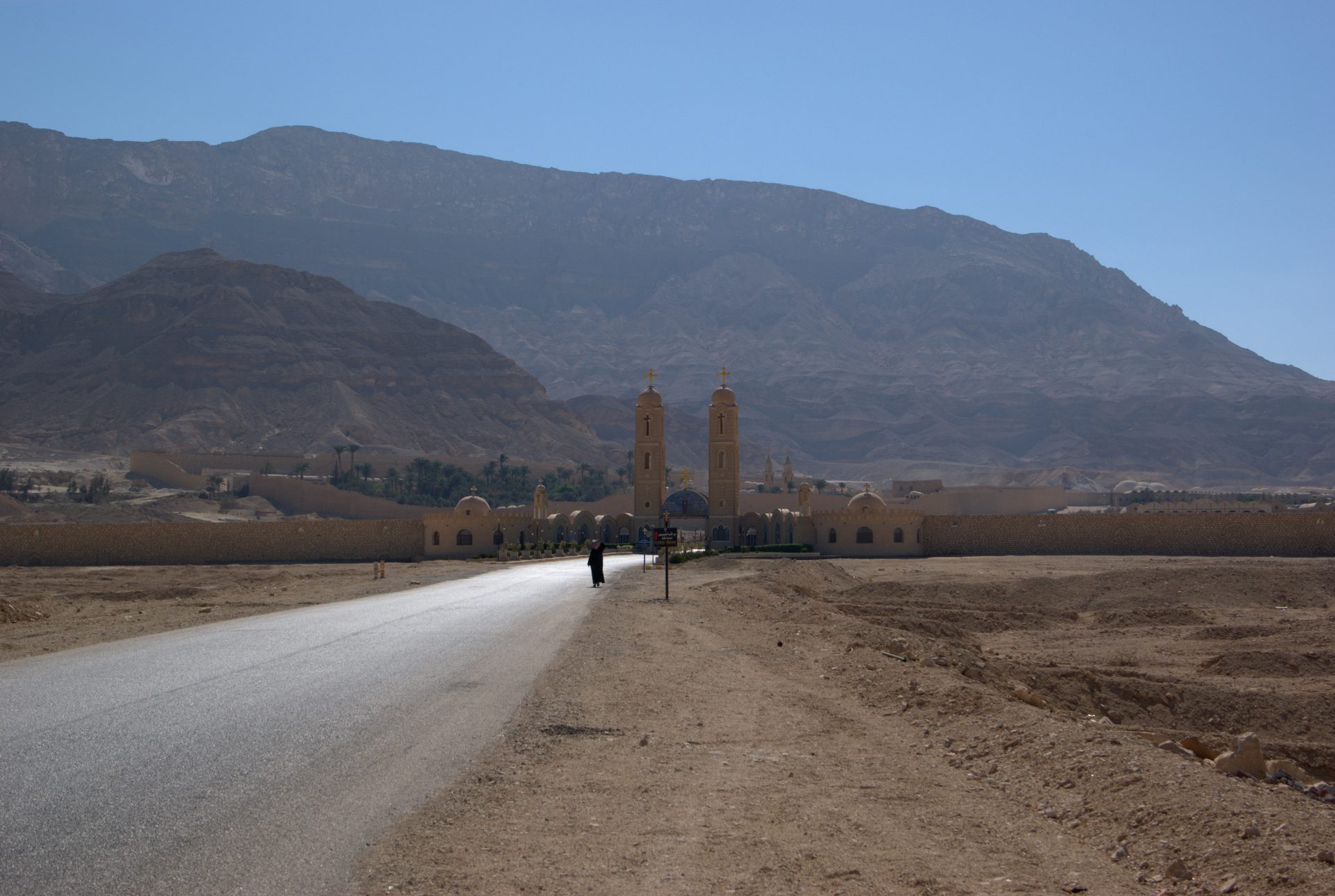
Egypt gave early Christianity two elements that outlasted it. One was a school. Alexandria's catechetical school was where Origen and his successors argued Christian doctrine into its final shape, and for two centuries or so it was the most serious address in the faith. The other was the monastery. When AnthonyAnthony St Anthony of Egypt (c. 251–356), the hermit whose retreat into the Eastern Desert is taken as the beginning of Christian monasticism.Encyclopaedia Britannica. View source ↗ walked into the Eastern Desert around 270 AD he does not seem to have been founding anything. He wanted to be left alone. People followed him anyway, and a few decades later Pachomius wrote the first monastic rule, which is the point at which the desert became a system. That system reached Ireland and Ethiopia within a few centuries.
The church calls itself the church of the martyrs and it counts its years accordingly. Year one is 284 AD, when Diocletian became emperor; his persecution fell hardest on Egypt. Coptic dates are still written AM, for Anno Martyrum, the Era of the Martyrs. By that reckoning it is now the year 1742.
The break with the rest of Christianity came at the Council of Chalcedon in 451, over how to describe the divine and the human in Christ. The textbooks call the Coptic position miaphysite; Copts themselves just say orthodox. To outsiders the argument has always sounded like hair-splitting. To the churches it split, it never was.
Then came the Arab conquest of 641. Becoming a minority took centuries rather than years: the jizya, the tax levied on non-Muslims, did much of the work, along with the ordinary advantages of belonging to the ruling faith. What the Copts kept was the country's oldest name for itself — the Greek Aigyptios became qibt in Arabic and Copt in English. They kept the language too. Coptic faded out of the streets during the medieval period and survived at the altar, which is where ChampollionChampollion Jean-François Champollion (1790–1832), the French scholar who deciphered Egyptian hieroglyphs in 1822. He learned Coptic first, and used it as the key.Encyclopaedia Britannica. View source ↗ found it: he learned Coptic first, and that is how the Rosetta Stone was cracked.
What sets them apart
Pharaoh's heirs at the altar
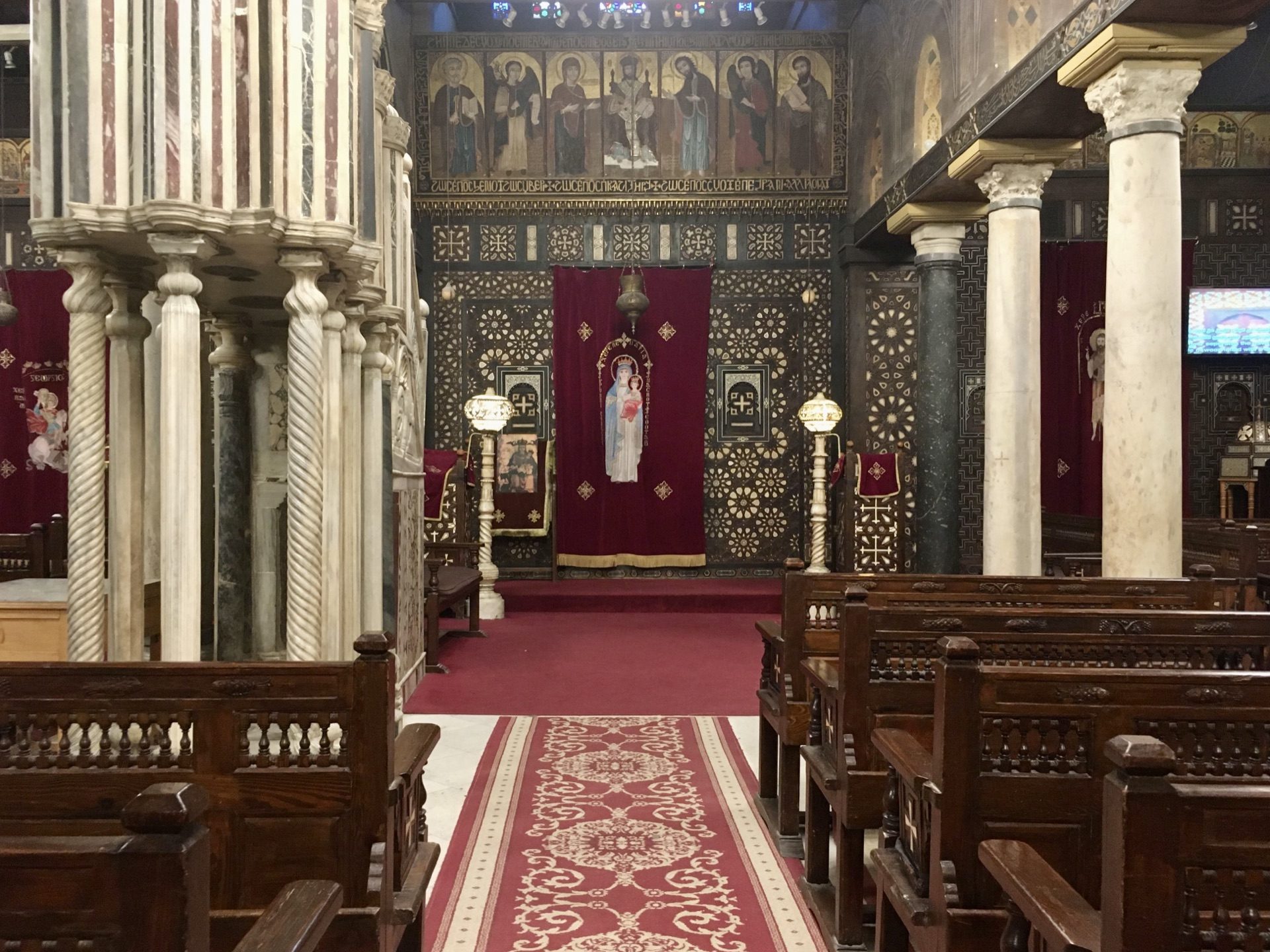
What sets the Copts apart is continuity more than doctrine. The language, the calendar and the fasting have all been carried along, largely intact, by a church that has never been a branch of anyone else's.
The cross on the wrist
A great many Copts have a small cross tattooed on the inside of the right wrist, usually done in childhood. It is a permanent mark of who you are, which is the point of it. It cannot be taken off at a checkpoint or in a conversion office. Tattooists work outside the big churches in Cairo. The custom is old, though nobody can date it properly.
A church that fasts
Copts fast for more than two hundred days a year, counting Advent, Lent, the Fast of the Apostles, the Fast of Nineveh and the Fast of the Virgin. Fasting here means no animal products at all, which makes Coptic cooking a large vegan tradition. It is also the practice that most reliably marks out a practising household.
The pharaohs' language, sung
Coptic is the last stage of ancient Egyptian, written in Greek letters with a few extra signs borrowed from the older script. It stopped being anyone's mother tongue long ago and stayed on in the liturgy, the only reason it survives at all. Some musicologists trace a few of the melodies to temple chant; others call that wishful. The evidence is thin either way.
The desert revival
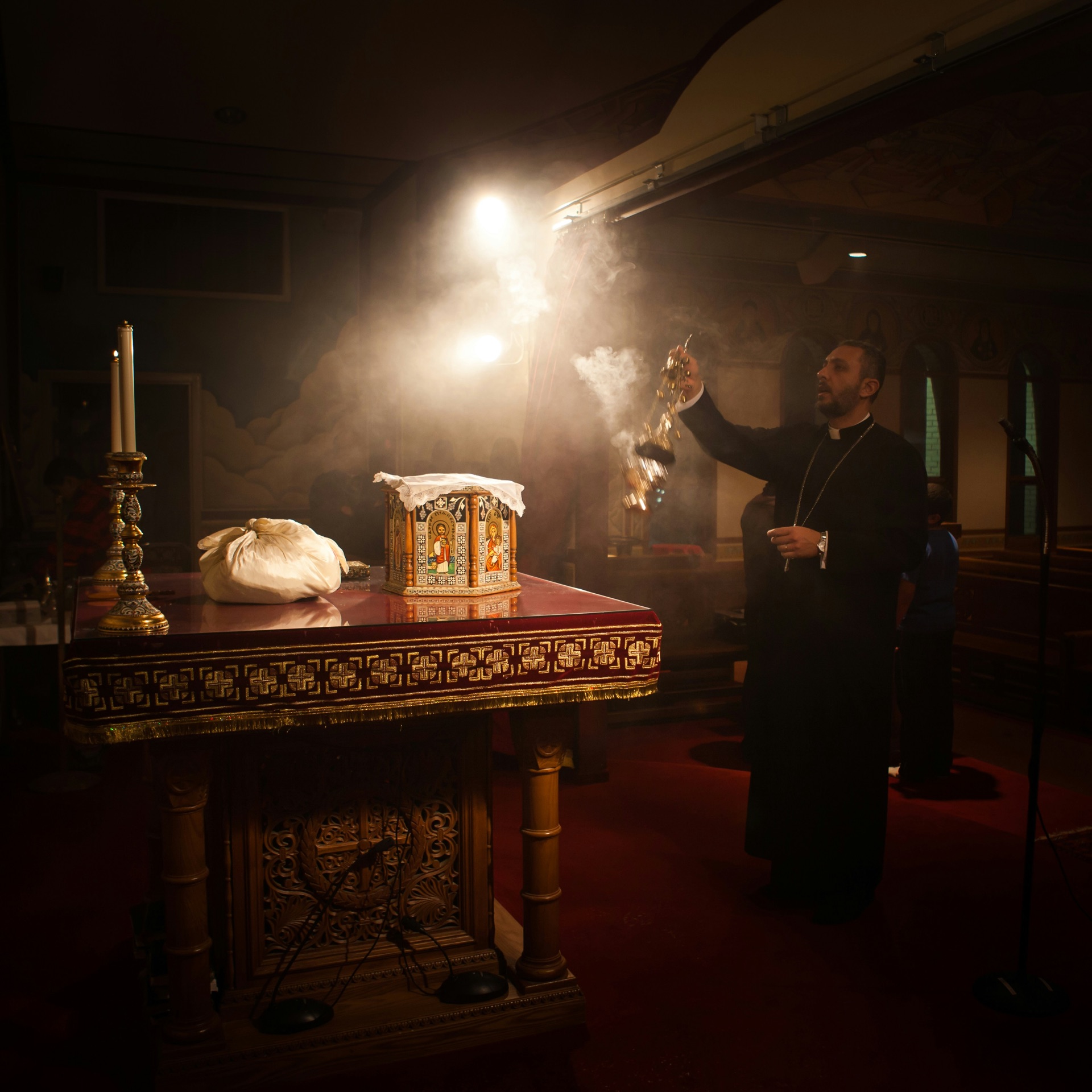
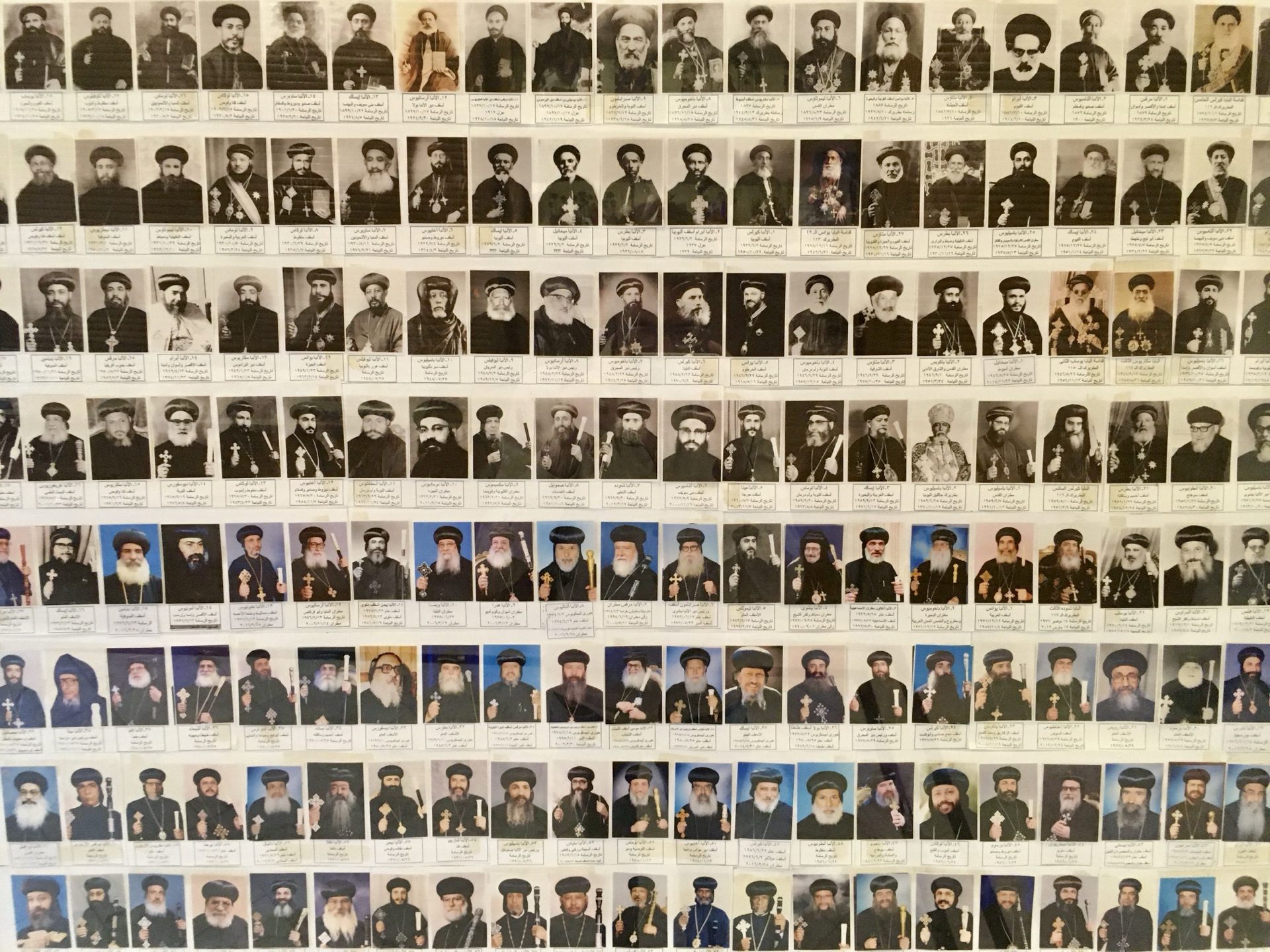
The ancient monasteries at Wadi Natrun and in the Red Sea mountains were nearly empty by the early twentieth century. From the 1950s onwards university graduates began entering them, which was not what anyone had predicted. Engineers and pharmacists became monks. One of that generation, Shenouda III, became pope in 1971 and ran the church for forty years.
1971 — today
Martyrs' era, modern chapter
The modern Coptic story runs along two lines at once and they do not cancel each other out. One is institutional growth. Under Shenouda III and his successor Tawadros II the church built more than it had in centuries. Schools, clinics, satellite channels, and a cathedral outside Cairo that seats thousands.
The other line is the attacks. A bomb outside a church in Alexandria on the first day of 2011 killed twenty-three people. The Botroseya church in Cairo was bombed in 2016, and two more churches, in Tanta and Alexandria, on Palm Sunday in 2017. In 2015 the Islamic State beheaded twenty-one migrant workers on a beach in Libya. Twenty of them were Egyptian Copts. The church canonised them within a week and their icon now hangs a long way beyond Egypt.
Copts are present at every level of Egyptian life, which the attacks tend to obscure. There are Coptic business dynasties, government ministers, and a former Secretary-General of the United Nations in Boutros Boutros-Ghali. Underneath that sits the ordinary grind. Permit rules that make building or repairing a church slow, blasphemy prosecutions, and disputes in Upper Egyptian villages that end with a family leaving. Minority Rights Group and the Egyptian Initiative for Personal Rights both document the village cases, and the pattern in them is fairly consistent.
Emigration has built a diaspora of maybe two million, mostly in the United States, Canada and Australia. Its money and its cathedrals now help support the church at home. The calendar still counts the Era of the Martyrs, and the community keeps adding to it. It also keeps growing.
We date our years from a persecution, and we are still counting.The Coptic calendar — Anno Martyrum, the Era of the Martyrs
Geography
Where they live
Based on work by Dr. M. Izady, Atlas of the Islamic World and Vicinity (New York: Columbia Univ, 2006–present) @ gulf2000.columbia.edu/maps.shtml
Through time
Timeline
- c. 42 ADSt Mark in Alexandria. Tradition dates the church's founding to the evangelist and the cobbler Anianus.
- 284The Era of the Martyrs begins. Diocletian's persecution becomes year one of the Coptic calendar.
- c. 270–356Anthony in the desert. Egyptian hermits invent Christian monasticism; Pachomius writes the first rule.
- 451Chalcedon. The Copts reject the council's formula — the birth of Oriental Orthodoxy.
- 641The Arab conquest. Egypt enters the Islamic world; the long demographic ebb begins.
- 1971–2012Shenouda III. Monastic revival, Sunday Schools movement, diaspora cathedrals — and rising sectarian strain.
- 2011–17The years of the bombs. Alexandria, Botroseya, Palm Sunday, Libya's beach: hundreds of new martyrs.
- TodayOne Egyptian in ten. The region's largest minority by an order of magnitude — building, burying, and staying.
One Egyptian in ten
Estimated population
Egypt has published no religious census figures since 1996; 10% of ~106 million is the standard estimate, church claims run higher and official hints lower. The diaspora is led by the USA, Canada and Australia.
What they gave the region
Egypt's second calendar
The most widely used Coptic gift is a calendar. Egyptian farmers plant by the Coptic months whatever their religion, because those months follow the Nile year rather than the Islamic lunar one. Ask a farmer in the delta about Tuba or Amshir and the answer will be about weather.
Monasticism is the larger export. It was invented in the Egyptian desert and it reshaped Christianity as far away as Ireland and Ethiopia. Coptic textiles are the other thing museums want, and there are good collections in the Louvre and the Victoria and Albert. In modern Egypt the community's imprint runs through business and cinema, from the Sawiris family to screen actors most Egyptians could name.
Coptic words still sit inside Egyptian Arabic, mostly the vocabulary of fields, water and bread.
Looking forward
Building faster than leaving
The Coptic future is usually described as a race between building and leaving. The building is real enough. So is the emigration, and there are no reliable numbers for either.
Treatment by the state has warmed at the top. A president attends the Christmas liturgy, a large basilica went up in the new administrative capital, and the church-building law was loosened in 2016. Whether any of that has changed things in a village in Minya is a separate question. The reporting from Minority Rights Group suggests not very much.
Ten million people do not disappear, so the demographic question is not really survival. It is texture. Copts might stay woven through every Egyptian street and profession, or they might end up living mostly inside church institutions, with their own schools and clinics and channels. Both are happening at the same time.
The emblem
The cross on the wrist
The equal-armed cross inside a circle is close to the form most often tattooed on Coptic wrists. The four dots are the four evangelists, in the old manner. The ring is eternity, which is what the desert fathers went out there looking for.
Sources11
- CIA World Factbook, Egypt – people and society. cia.gov
- William Harmless, Desert Christians: an introduction to the literature of early monasticism (Oxford University Press), 2004.
- Stephen J. Davis, The early Coptic papacy: the Egyptian church and its leadership in late antiquity (American University in Cairo Press), 2004.
- Encyclopaedia Britannica, Jean-François Champollion. britannica.com
- Mark N. Swanson, The Coptic papacy in Islamic Egypt (American University in Cairo Press), 2010.
- Sebastian Elsaesser, The Coptic question in the Mubarak era (Oxford University Press), 2014.
- Egyptian Initiative for Personal Rights, documentation of sectarian violence. eipr.org
- Human Rights Watch, Egypt: events of 2023, World report 2024, 2024. hrw.org
- Minority Rights Group, Copts in Egypt – community profile. minorityrights.org
- Gawdat Gabra, Coptic civilization: two thousand years of Christianity in Egypt (American University in Cairo Press), 2014.
- Tahrir Institute for Middle East Policy, brief on the 2016 church-construction law, 2016.