Legend & origins
The laughing child and the two spirits
Legend says Zarathustra laughed at his own birth. No other baby has ever managed it, according to the tradition, and he did it because he could already see the war he had been born into. On one side Ahura Mazda, the Wise Lord. On the other the Lie. Humanity in the middle, free to choose.
The ideas that came out of that vision are now so ordinary that it is hard to see them as anyone's invention. One God above the rest. A cosmic struggle between good and evil. Judgment after death, a saviour still to come, and a final repair of the world. Persian empires carried all of it from the Nile to the Indus. Scholars have spent a century arguing about how much then passed into Judaism, Christianity and Islam: the direction of borrowing is hard to prove, and the dating is worse.
Zarathustra's own dates are guesswork. The range on offer runs from about 1500 BC to about 600 BC, depending mostly on how archaic a scholar judges the language of the Gathas to be — the seventeen hymns attributed to Zarathustra himself, and the oldest part of the scripture.
The Arab conquest of the seventh century started a long decline, and it was slow. The jizya, the tax on non-Muslims, did most of it, along with the everyday advantages of conversion and occasional violence on top. The community ended up concentrated in Yazd and Kerman. Those are two desert cities in central Iran, remote enough at the time to be largely ignored.
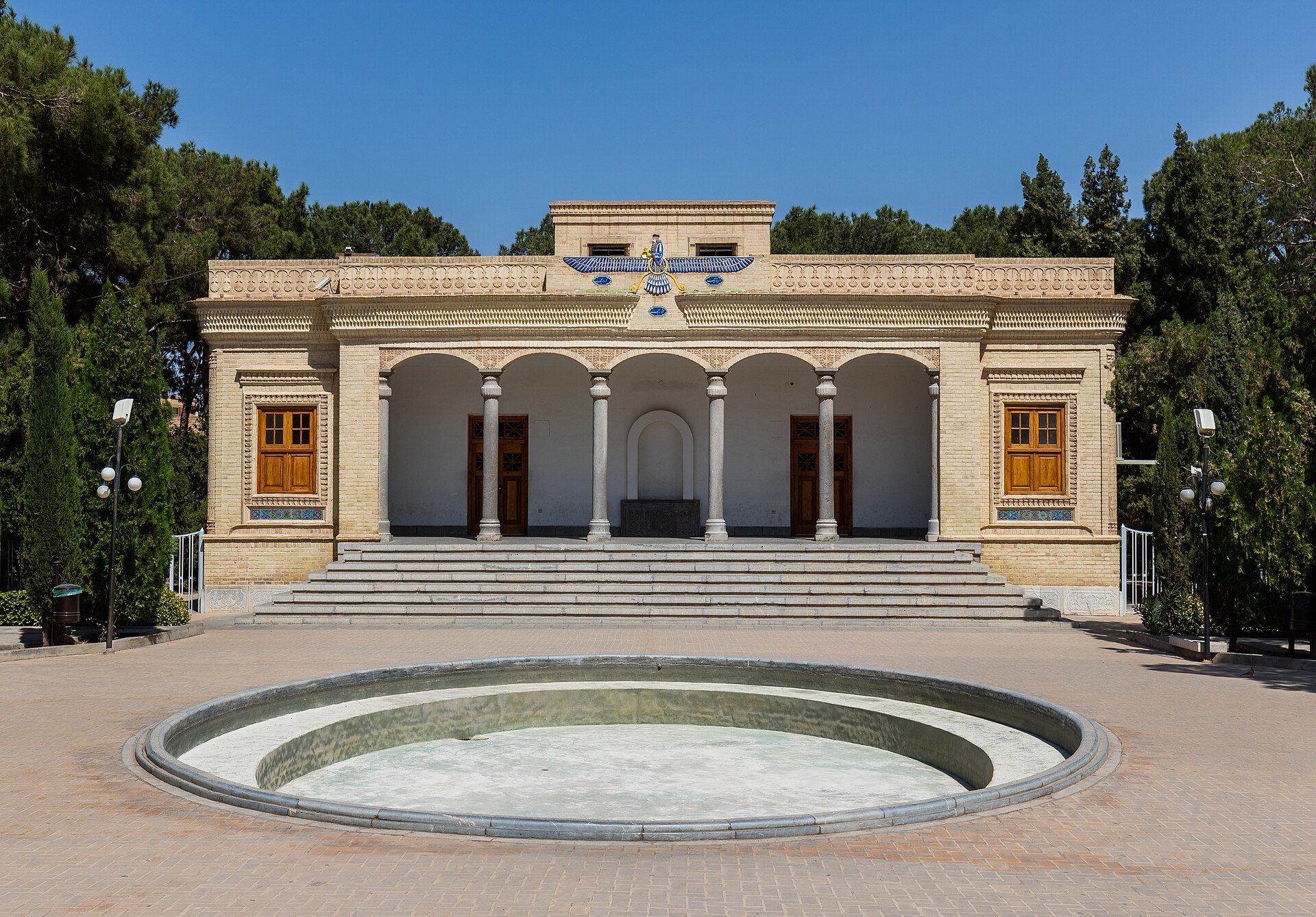
One group left. By tradition a shipload sailed for Gujarat in the tenth century, and their descendants are the Parsis of India. The ones who stayed kept the fires going: the Atash Bahram in Yazd is said to have burned without interruption for more than 1,500 years — the community's own claim, and unverifiable.
What sets them apart
The religion of the elements
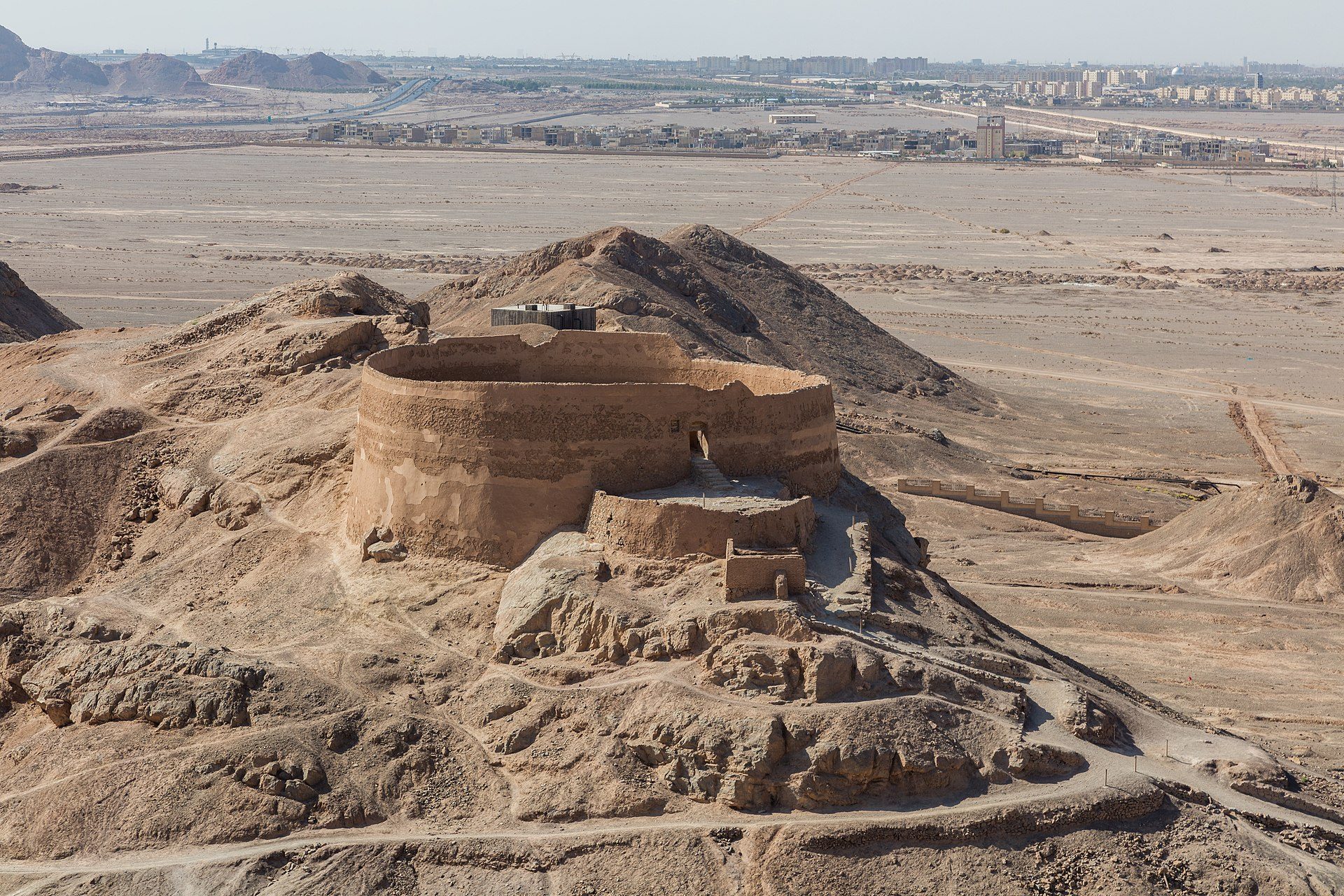
Zoroastrian practice treats the physical world as sacred and easily spoiled. Fire, water, earth and air are all creations of the Wise Lord, and a great deal of the ritual law is about not polluting them.
The fire that is never let out
Fire is not worshipped. It is treated as truth made visible, a distinction the community has been explaining to outsiders for about fourteen centuries. Temple fires are graded by how elaborately they were consecrated. The highest grade is called an Atash Bahram. It is assembled from sixteen separate fires, one of which has to come from lightning, and after that it is never allowed to go out.
Nowruz and the winter bonfire
Nowruz, the Persian new year that most of the region now celebrates, is Zoroastrian in origin. So is Sadeh, a midwinter feast built around a large communal bonfire, which is the community's most visible public event inside Iran. Plenty of non-Zoroastrians turn up to both.
Good thoughts, good words, good deeds
The whole ethical system compresses into three words: humata, hukhta, huvarshta. Good thoughts, good words, good deeds. The compression loses a lot; at least it is the community's own.
The shirt and the cord
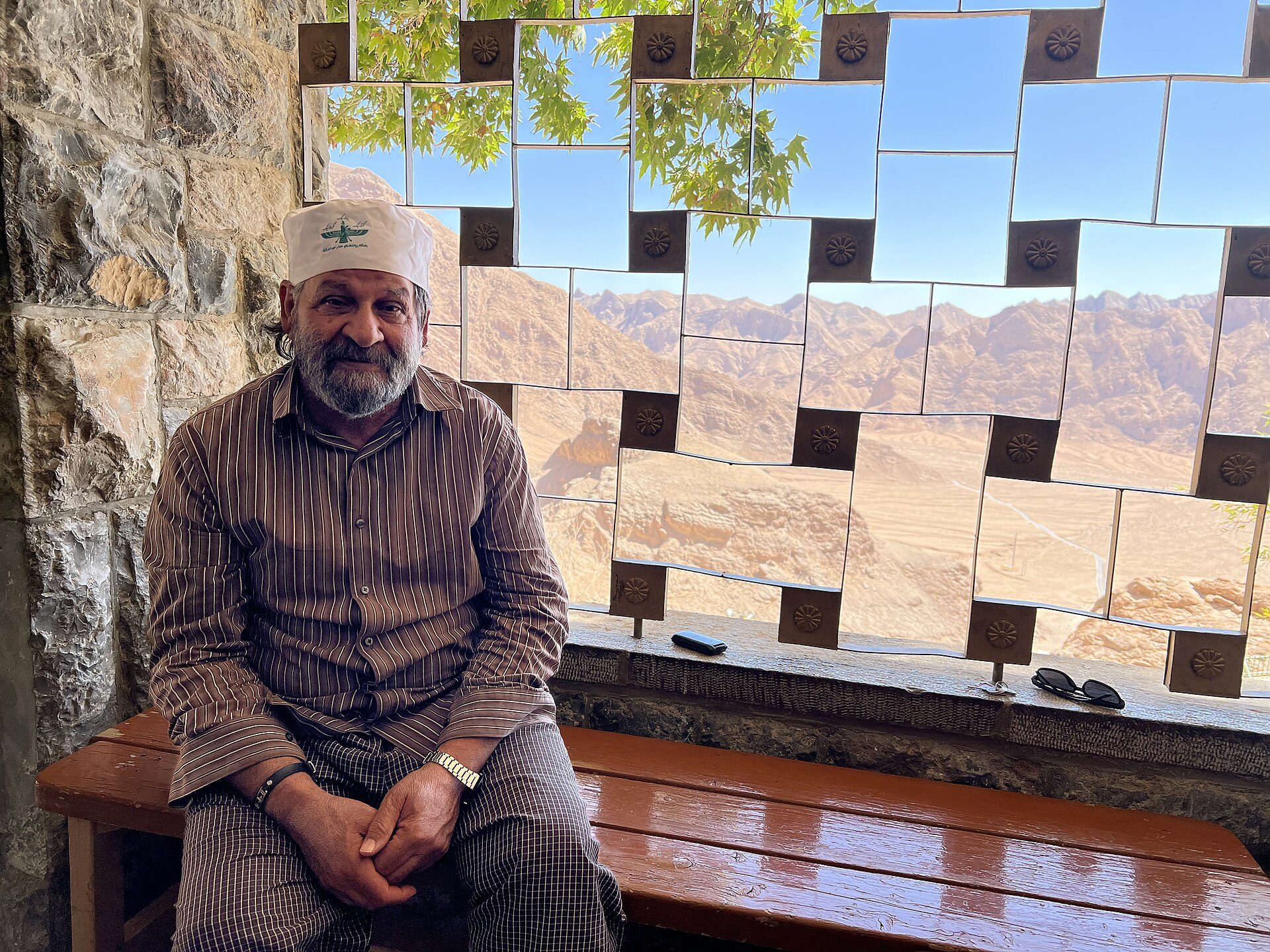
At initiation, which is called sedreh-pushi, a child is given a white cotton shirt and a cord woven from seventy-two lambswool threads. The number matches the chapters of the Yasna, the main liturgy. The cord is untied and retied during prayer, several times a day for the observant, and it is worn under ordinary clothes for life.
Iran today
A tolerated remnant, a quiet pride
The Islamic Republic recognises Zoroastrians as a protected religious minority. In practice that means temples, schools, associations and one reserved seat in parliament, which is more than most minorities anywhere have in writing.
It also means ceilings. Senior state office is closed to them. Inheritance law has historically favoured a relative who converts to Islam, though that provision was amended and how far it still bites is disputed. Conversion into the faith is not legally possible in Iran, and the priesthood there has not been keen on it either.
The numbers are contested in the usual way. Iran's 2016 census counted around 23,000. Community estimates run higher, sometimes as high as 60,000. Nobody has much incentive to be precise, and the census asks a question that people have reason to answer carefully. Tehran now holds the largest single community, ahead of Yazd.
Meanwhile the standing of the faith inside Iran has probably never been higher. Nowruz, Yalda and Sadeh are kept by Iranians of every persuasion. The Faravahar, the winged figure from the Achaemenid reliefs, is one of the most common pendants in Iranian jewellery shops. A community of 25,000 has ended up as the custodian of symbols that a nation of ninety million borrows.
There is but one path: the path of Truth. All else is no path.Attributed to Zarathustra — the Gathas
Geography
Where they live
Based on work by Dr. M. Izady, Atlas of the Islamic World and Vicinity (New York: Columbia Univ, 2006–present) @ gulf2000.columbia.edu/maps.shtml
Through time
Timeline
- c. 1200–1000 BCZarathustra teaches. The Gathas are composed on the Iranian plateau; dating remains scholarly guesswork.
- 550–330 BCFaith of an empire. The Achaemenids rule from the Nile to the Indus under Ahura Mazda's wing.
- 224–651 ADSasanian orthodoxy. Zoroastrianism becomes a state church with a high priesthood — and its own persecutions of others.
- 651The Arab conquest. The last shah falls; thirteen centuries of minority life begin.
- c. 936The sailing to India. By tradition, emigrants from Khorasan land in Gujarat — the origin of the Parsis.
- 1854The Parsi rescue. Bombay Parsis send emissaries who eventually win abolition of the jizya for Iran's Zoroastrians.
- 1979Revolution. Recognised-minority status under the Islamic Republic: one MP, real protections, real ceilings.
- Today25,000 and the symbols of a nation. A shrinking community whose festivals and Faravahar all Iran has adopted.
The remnant and the sea
Estimated population
Iran's 2016 census counted ~23,000; community claims reach 60,000. The worldwide figure is dominated by India's Parsis (~50,000) and growing North American communities.
What they gave the region
The faith the region borrowed from
Zoroastrian ideas sit underneath a good deal of the region's religion, though the borrowing is argued over rather than settled. One God. Judgment, heaven and hell. A saviour to come, and the world repaired at the end of it. Each of those has a Zoroastrian version older than the version most people know.
The gifts that are not in dispute are the festivals. Nowruz is the big one, and it is now a public holiday from Albania to Kazakhstan. Yalda, the longest night of the year, is kept with fruit and poetry. Chaharshanbe Suri involves jumping over fires in the street, which the authorities periodically discourage. Sadeh is the bonfire.
The Persian garden is the quiet one. Its fourfold plan, four quarters divided by water channels, comes out of Zoroastrian sacred landscaping. So does the word paradise, which reached English through Greek from an Old Persian word for a walled enclosure.
Looking forward
Small flame, strong draught
The Iranian community keeps getting smaller: emigration to North America runs ahead of births, and there is no conversion to offset it. Its cultural position is going the other way. Young Iranians wear the Faravahar as a mild form of dissent, Yazd's temples draw a growing pilgrim-tourism, and the diaspora funds restoration work that the state permits because heritage is good politics.
The open question is whether the doors open. Diaspora communities in North America and India increasingly accept converts and the children of mixed marriages. Iran's priesthood resists it, and so do plenty of Parsi institutions in Mumbai. The argument is nowhere near settled.
The emblem
The eternal flame
The fire altar, a flame in a raised brazier, is the oldest emblem the faith has — older than the Faravahar, which is the one the modern world knows. Fire is truth made visible, so the history of the community can be told as the custody of a flame.
Sources10
- Mary Boyce, Zoroastrians: their religious beliefs and practices (Routledge), 2001.
- Encyclopaedia Britannica, Zoroastrianism. britannica.com
- Prods Oktor Skjaervo, The spirit of Zoroastrianism (Yale University Press), 2011.
- Jamsheed K. Choksy, Conflict and cooperation: Zoroastrian subalterns and Muslim elites in medieval Iranian society (Columbia University Press), 1997.
- Mary Boyce, A Persian Stronghold of Zoroastrianism (Oxford University Press), 1977.
- John R. Hinnells, The Zoroastrian diaspora: religion and migration (Oxford University Press), 2005.
- Eliz Sanasarian, Religious minorities in Iran (Cambridge University Press), 2000.
- Statistical Centre of Iran, 2016 national census, religion tables, 2016.
- Norman Cohn, Cosmos, chaos and the world to come: the ancient roots of apocalyptic faith (Yale University Press), 1993.
- United Nations, International Day of Nowruz. un.org