Legend & origins
The Gate and the Glory
On an evening in Shiraz in May 1844, a young merchant told a single traveller that he was the Báb, meaning the Gate, and that he was the herald of someone greater than himself. Within six years he had shaken Persia and been executed by firing squad in Tabriz. Within twenty, a prisoner called Bahá'u'lláh, the Glory of God, had declared himself the one foretold.
From a prison city in Ottoman Palestine, Bahá'u'lláh wrote the core of the faith into being. Humanity is one. The great religions are chapters of one unfolding revelation. Men and women are equal. Science and religion are twin lights. The earth is one country and mankind its citizens.
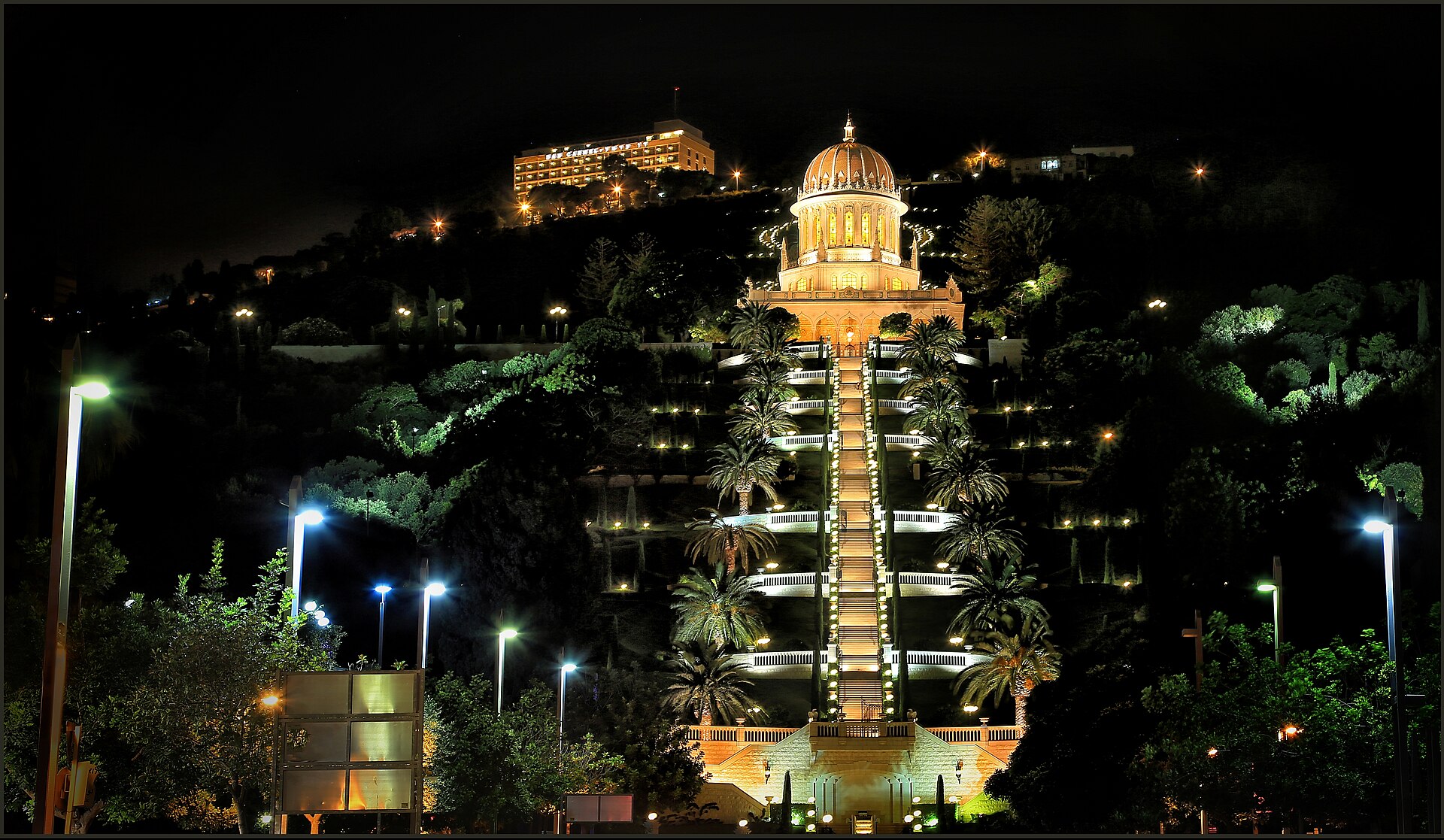
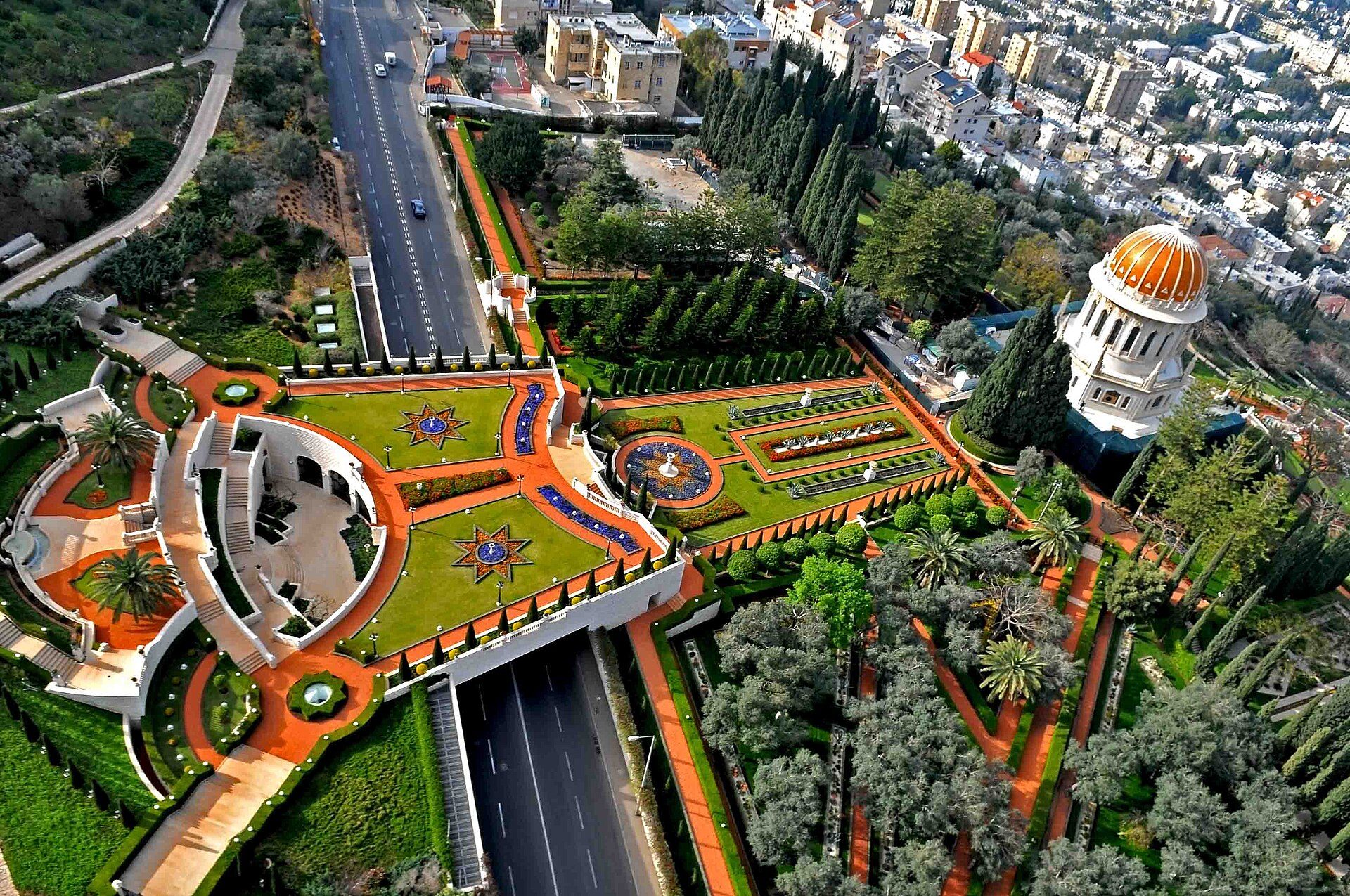
He died near Acre in 1892. His shrine there, and the golden-domed shrine of the Báb on Mount Carmel, made the corridor between Haifa and Acre the world centre of the faith: a geography chosen by exile rather than by conquest.
In Iran the movement was answered from the first with pogroms: Bahá'í tradition counts 20,000 early believers killed in the nineteenth century, scholars two to three thousand, and the pattern never fully stopped. What began at a doorway in Shiraz now counts several million adherents in virtually every country — the most geographically dispersed religion after Christianity — governed without clergy, by elected councils.
What sets them apart
A religion built like a parliament
The Baha'i faith deliberately threw out the machinery of older religions. No clergy, no sacraments in the classical sense, no national churches. What replaced them looks less like a church than like a civic constitution.
No clergy at all
Local, national and international affairs run through elected assemblies of nine members. Nobody preaches for a living. Campaigning for office is forbidden outright, so candidates do not know they are candidates until the votes are counted.
The nineteen-day rhythm
The Baha'i calendar has nineteen months of nineteen days. Each month opens with the Nineteen Day Feast, which combines worship, community consultation and food, and which is the basic institution of Baha'i life.
A fast of nineteen days
Adults fast from sunrise to sunset through the final month of the year. It ends at Naw-Rúz, the Persian new year, carried into a new religion and kept on the same date.
Education as worship
Literacy and what Baha'is call the independent investigation of truth are religious duties. That is one reason Iran's ban on university entry for Baha'is cuts as deep as it does, and why the community answered it by building a university of its own.
Iran, 1979 — today
The price of a new prophet
Islamic theology holds Muhammad to be the final prophet. A religion founded after him, by Iranians, was therefore received as apostasy in its purest form. That is the root of everything that follows, and it is why the persecution has outlasted several very different Iranian governments.
Since 1979 more than 200 Baha'is have been killed, among them two successive national assemblies: the first abducted and never seen again, the second executed. Thousands have been imprisoned. Baha'is are barred from universities and public employment, their cemeteries have been bulldozed, their marriages went unrecognised for decades and their property has been confiscated by revolutionary decree — documentation the Bahá'í International Community maintains, and human-rights organisations generally find reliable.
The community's response has been studiedly nonviolent. Documentation, court petitions, and the Baha'i Institute for Higher Education, a clandestine university taught in living rooms and by exiled academics online. A number of Western universities quietly accept its degrees.
Elsewhere in the region, communities in Egypt, Jordan, Tunisia and the Gulf live in various shades of legal ambiguity. The region that produced the faith remains, almost everywhere, the hardest place to profess it.
The earth is but one country, and mankind its citizens.Bahá'u'lláh
Geography
Where they live
Based on work by Dr. M. Izady, Atlas of the Islamic World and Vicinity (New York: Columbia Univ, 2006–present) @ gulf2000.columbia.edu/maps.shtml
Through time
Timeline
- 1844The Báb declares in Shiraz. The faith's calendar begins; Persia convulses.
- 1850The Báb executed in Tabriz. A regiment's volley; the remains are hidden by followers for six decades.
- 1852–92Bahá'u'lláh's exiles. Tehran dungeon to Baghdad, Constantinople, Adrianople and the prison city of Acre — writing all the way.
- 1909The Báb interred on Carmel. The golden shrine fixes the faith's geography on the Haifa–Acre corridor.
- 1979Revolution in Iran. Executions, confiscations and exclusion codified; the persecution becomes systematic policy.
- 1987The BIHE founded. The underground university becomes the community's flagship act of constructive resistance.
- TodaySeveral million, everywhere but home. The most dispersed religion on earth after Christianity, still unrecognised in its birthplace.
Largest at home, freest abroad
Estimated adherents
Iran's Baha'i population is necessarily an estimate — the census offers no box for them. Worldwide figures of 5–8 million include large communities in India, Africa and the Americas.
What they gave the region
Blueprints for a smaller world
The Baha'i gift is institutional imagination. Elected councils without clergy. Houses of worship open to every faith. A development network of schools and literacy programmes run on the teaching that service is a form of worship.
Haifa's terraced gardens are among the most visited sites in the region, built by a faith that, in that city, does not even seek converts.
Persia itself owes the movement some of its first girls' schools, and hospitals that were open to everyone. The community built those institutions a century before the state got round to it, and paid for them in blood.
Looking forward
Waiting out the storm at home
Globally the faith grows and normalises. Temples on every continent, and a standing in international law as something close to the test case for religious persecution.
In Iran the strategy is what Baha'is call constructive resilience. Document every confiscation, educate every barred student through the underground university, and refuse both violence and exile as a matter of policy.
Every Iranian opening, in 2009 and again in 2022, has brought Baha'is unexpected allies among compatriots who once shunned them. Public letters of apology from Iranian intellectuals now circulate openly. The community's bet is generational: the Iran that eventually changes will find its most patient citizens already practised at building institutions under pressure.
The emblem
The nine-pointed star
Nine is the number of completeness in this faith, because nine is the numerical value of the word Bahá in the abjad reckoning, the old system that gives every Arabic letter a number. Hence nine-sided temples, nine-member assemblies, and the nine-pointed star that Baha'is wear where older faiths wear a cross or a crescent.
Sources10
- Abbas Amanat, Resurrection and renewal: the making of the Babi movement in Iran, 1844-1850 (Cornell University Press), 1989.
- Juan R. I. Cole, Modernity and the millennium: the genesis of the Baha'i faith in the nineteenth-century Middle East (Columbia University Press), 1998.
- Peter Smith, An Introduction to the Baha'i Faith (Cambridge University Press), 2008.
- Moojan Momen, The social basis of the Babi upheavals in Iran, 1848 to 1853 (International Journal of Middle East Studies), 1983.
- Bahá'í International Community, The situation of the Bahá'ís in Iran. bic.org
- Bahá'í Institute for Higher Education, bihe.org. bihe.org
- Baha'i International Community, The Baha'i question revisited: persecution and resilience in Iran, 2016.
- UNESCO World Heritage Centre, Baha'i holy places in Haifa and the Western Galilee, world heritage list inscription, 2008.
- Soli Shahvar, The forgotten schools: the Baha'is and modern education in Iran, 1899-1934 (I.B. Tauris), 2009.
- UN Special Rapporteur on Iran, reports to the Human Rights Council.