Legend & origins
Four ancestors and a hidden book
Shabak tradition traces the community to wandering dervishes — travelling Sufi preachers — who settled the plain east of Mosul about five hundred years ago. Some say they are heirs of the Safavid order's lost followers, stranded when the empires redrew their borders.
Their sacred book is the Buyruk, the Command. It is written in Turkoman and kept by a small number of religious families; most Shabak have only ever met it through their pirs, the spiritual guides who stand between the faithful and the divine. The role is inherited, not trained for.
The structure has much more in common with Alevi and Yarsan practice than with mosque Islam. Religion here is initiation and lineage rather than public congregation. There is no Friday sermon and no clergy in the ordinary sense.
Who the Shabak really are has been argued about for a century. Kurdish tribes, Turkoman settlers, or a people of their own. Their language, Shabaki, belongs to the Zaza and Gorani group. That group is related to Kurdish without being Kurdish. Their poetry borrows Turkish. Their shrines share saints with their Yazidi and Christian neighbours.
One government after another has tried to settle the question by force. Saddam's censuses obliged them to register as Arabs and deported thousands who refused. After 2003 Kurdish and Arab politics started fighting over them again — from the outside it looks less like a dispute about identity than about who gets to count the plain.
What sets them apart
A faith that fits no census box
The Shabak are what happens when a frontier keeps its own counsel. A self-contained religious world on a plain that everybody else has claimed.
The pir and the Buyruk
Every Shabak family is bound to a hereditary spiritual guide, its pir. The teachings of the Buyruk pass down through these lineages rather than through public preaching.
Confession of the laity
Communal gatherings include an open confession of faults in front of the pir. There is no parallel to this in the Islam around them, though it is close to Alevi practice in Anatolia.
Shared shrines
Shabak villagers keep vows at Yazidi and Christian sanctuaries as readily as at their own. The holy places of the plain have always been common property.
Pilgrimage of the plain
Most Shabak lean Shia and go to Kerbala and Najaf, the two great shrine cities of southern Iraq. Alongside that there are local pilgrimage circuits that tie the sixty villages together in ways no state border managed to interrupt.
2003 — today
The most bombed minority nobody names
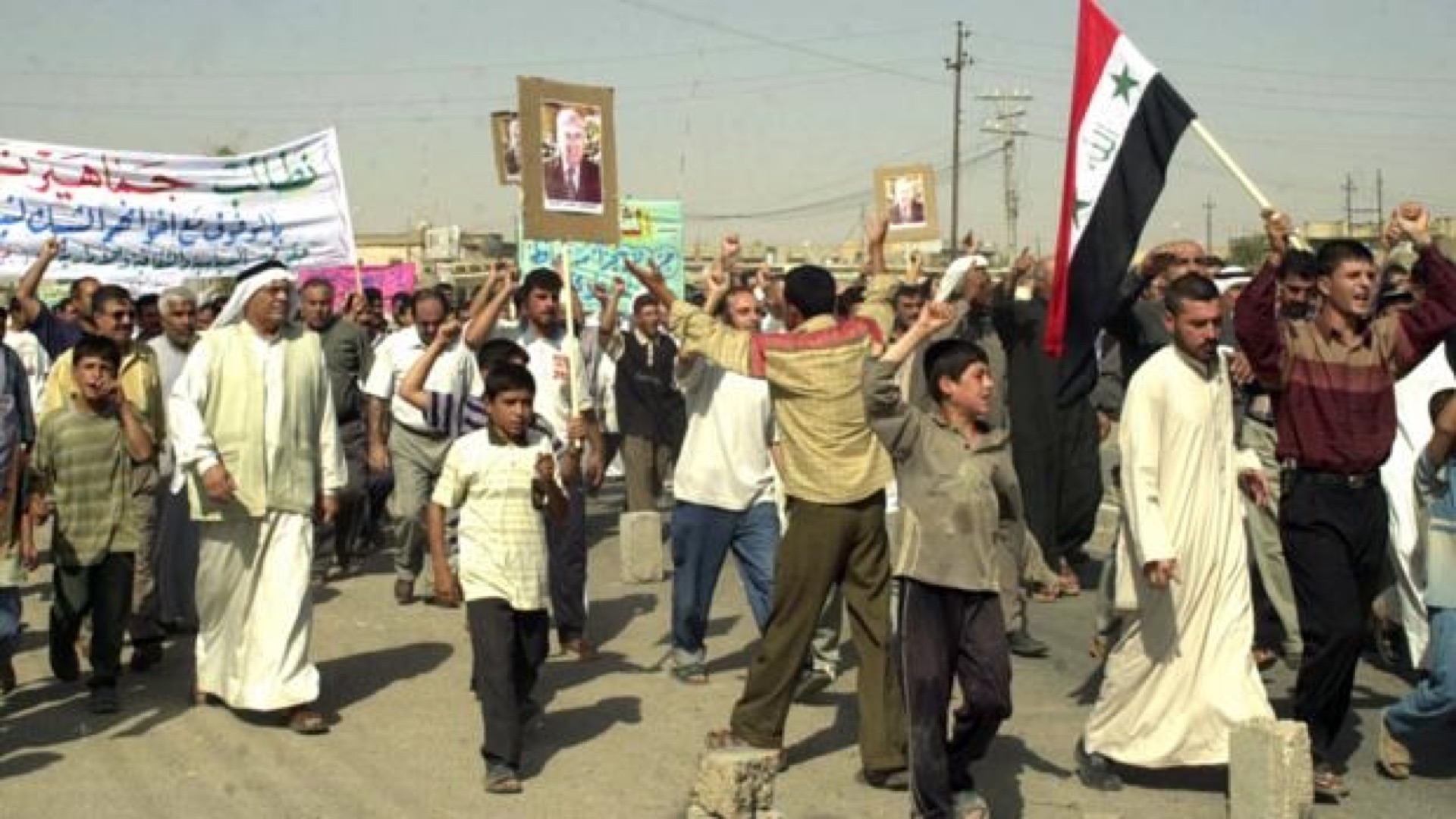
Visibility came late and it came badly. After 2003 the Shabak were Shia-leaning, not Arab and unarmed, which made them useful targets for al-Qaeda in Mosul: assassinations, leaflets telling them to get out, and in 2009 a truck bomb in the village of Khazna that flattened a quarter of the houses. More than 1,300 Shabak were killed in the decade before ISIS even arrived, and almost none of it reached an international audience.
In August 2014 ISIS took the plain. Shabak villages emptied in a night, hundreds of people were executed or disappeared, and the community scattered into camps in the Kurdistan Region alongside their Yazidi and Christian neighbours.
Most villages have been rebuilt since liberation and the Shabak now hold a reserved seat in the Iraqi parliament. The plain they came back to is militarised, disputed between Baghdad and Erbil, and emptier than it was.
Every state offered us its name. We kept our own.On a century of forced classification — Arab, Kurd, Turkoman
Geography
Where they live
Based on work by Dr. M. Izady, Atlas of the Islamic World and Vicinity (New York: Columbia Univ, 2006–present) @ gulf2000.columbia.edu/maps.shtml
Through time
Timeline
- 16th centurySettlement on the plain. Dervish groups of Zaza–Gorani speech settle east of Mosul under Ottoman rule; the Buyruk tradition takes root.
- 1988Anfal reaches the plain. Saddam's campaigns destroy Shabak villages; thousands are deported for refusing to register as Arabs.
- 2009The Khazna bombing. A truck bomb kills dozens and flattens much of a Shabak village — the worst of a decade of attacks.
- Aug 2014ISIS occupation. The plain is emptied; hundreds of Shabak are killed or disappear.
- 2017Liberation and return. Most villages rebuild; Shabak units join the Popular Mobilisation Forces, complicating local politics.
- TodayA reserved seat, a disputed plain. One guaranteed MP in Baghdad; a homeland still contested between federal Iraq and the Kurdistan Region.
A single-heartland people
Estimated population
Estimates range from 250,000 to 400,000. Unlike most communities in this atlas, the Shabak remain overwhelmingly in their homeland — displacement since 2014 has been internal.
What they gave the region
The plain's quiet weavers
Shabak culture is the connective tissue of the Nineveh Plain. Their poets composed in a blend of Gorani, Turkish and Arabic. Only a crossroads produces that. Their pirs kept alive a Buyruk tradition they share with the Alevis of Anatolia, eight hundred kilometres away. Ideas used to travel between mountain and plain a good deal faster than people did.
Shabak weaving and embroidery, in the bold reds and blacks of their folk dress, filled the markets of Mosul for centuries.
The thing worth borrowing from them is the shared shrine. Vows kept at Yazidi and Christian sanctuaries made the holy places of the plain common property. That is coexistence as a daily habit rather than a slogan. It did not save anyone in 2014. It is still probably the most hopeful arrangement anybody on that plain has come up with.
Looking forward
Staying, on a contested plain
The Shabak future is being decided at home, which makes them unusual in this atlas. They stayed. The open questions are political rather than demographic.
Whether the Nineveh Plain ends up under Baghdad, under Erbil or under some genuine local administration. Whether Shabak armed units turn out to be a guarantee or a provocation. And whether Shabaki, only recently written down and taught, survives schooling in Arabic and Kurdish.
They have a reserved seat in parliament and high birth rates. They also have five centuries of practice at staying put. The flags over that plain will probably change again. The Shabak will probably still be farming it.
The emblem
The ear of wheat
The Shabak have no old heraldry, so the emblem here is the wheat of the Nineveh plain they have farmed for five centuries. A people defined less by a symbol than by soil.
Sources10
- Michiel Leezenberg, The Shabak and the Kakais: Dynamics of Ethnicity in Iraqi Kurdistan (University of Amsterdam), 1994.
- Ahmad Hamid al-Sarraf, al-Shabak: min firaq al-ghulat fi al-Iraq (Baghdad), 1954.
- Minority Rights Group, Shabak in Iraq – community profile. minorityrights.org
- Krisztina Kehl-Bodrogi, Barbara Kellner-Heinkele and Anke Otter-Beaujean, Syncretistic religious communities in the Near East (Brill), 1997.
- Geoffrey Haig and Geoffrey Khan, The languages and linguistics of Western Asia: an areal perspective (De Gruyter Mouton), 2018.
- Human Rights Watch, Claims in conflict: reversing ethnic cleansing in northern Iraq, 2004. hrw.org
- Minority Rights Group & IILHR, No Way Home: Iraq's Minorities on the Verge of Disappearance, 2016.
- Human Rights Watch, On vulnerable ground: violence against minority communities in Nineveh Province's disputed territories, 2009.
- Amnesty International, Ethnic Cleansing on a Historic Scale, 2014. amnesty.org
- Minority Rights Group International, Crossroads: the future of Iraq's minorities after ISIS, 2017.