Legend & origins
A pearl, a peacock, and the birth of the world
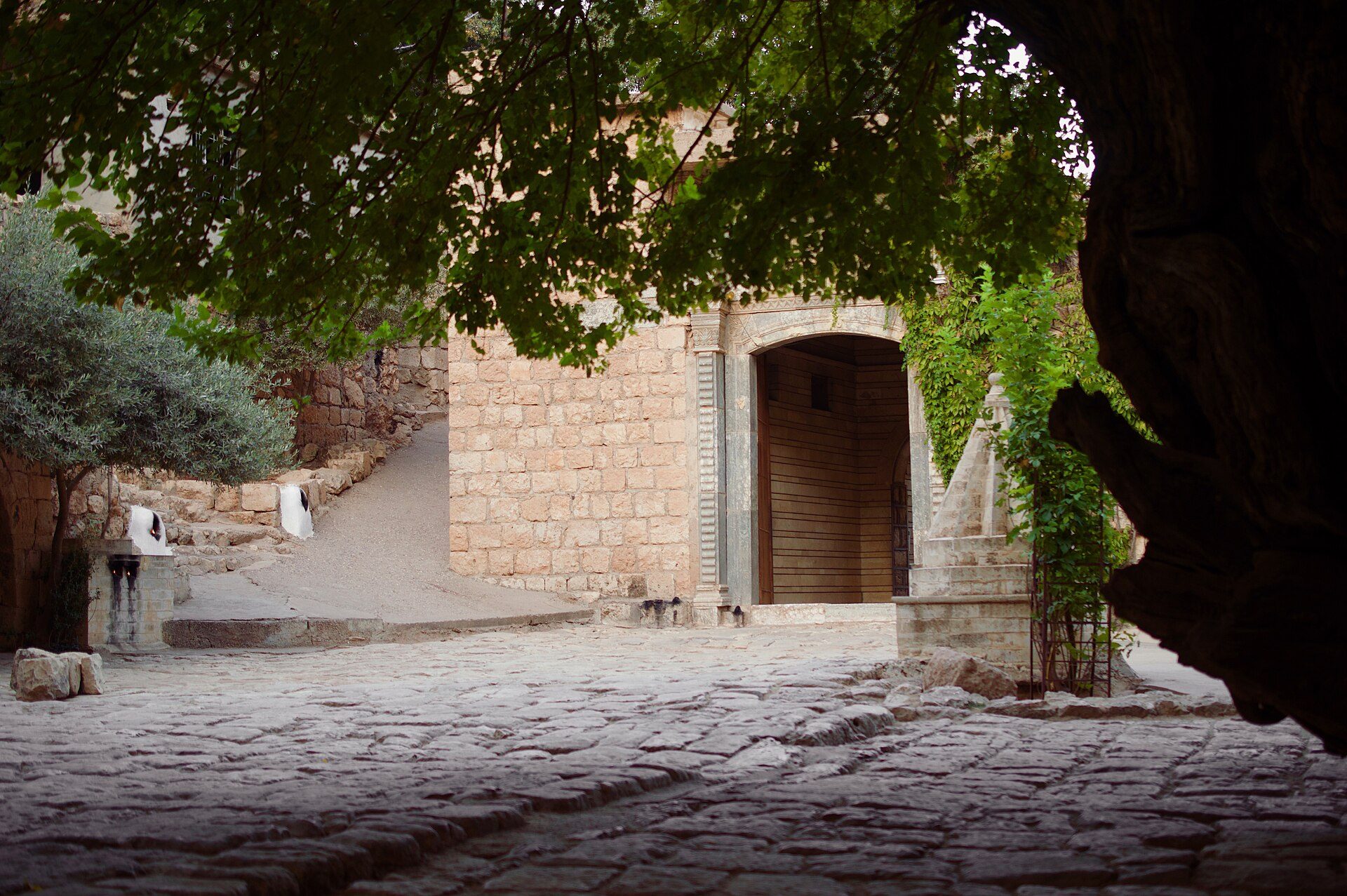
Yazidi tradition says that before the world existed, God created a pearl. It lay in the sea of eternity for forty thousand years. Then it shattered, and the world poured out of it. The first place its colours touched was the valley of Lalish.
Yazidis believe in one God who created the world and then handed its care to seven holy beings. Angels is the usual translation, though it is not quite right. The most important of them is Tawûsî Melek, the Peacock Angel. He refused to bow down to Adam. Yazidis insist he did this out of devotion to God alone, and not out of pride.
In the other monotheistic religions, an angel who refuses to bow is Lucifer. So outsiders looked at the Peacock Angel and saw the devil. Yazidis see the exact opposite. To them he is an angel who passed God's test. This is where the old label of devil-worshippers comes from. Ottoman pashas used it, ISIS revived it, and the Yazidis have never quite shaken it off.
The religion as you find it today took shape in the twelfth century. That is when the Sufi mystic Sheikh Adi ibn Musafir settled at Lalish, and his teaching mixed with much older Iranian tradition. There is no scripture to convert anyone with, and in fact no conversion at all. You are born Yazidi or you are not.
Yazidism is a religion in the first place. However, Yazidis may only marry inside their own community, and inside their own caste. Keep that up for eight centuries and a religion turns into a people as well, which is why most Yazidis today describe themselves as both.
What sets them apart
A religion of thresholds and lamps
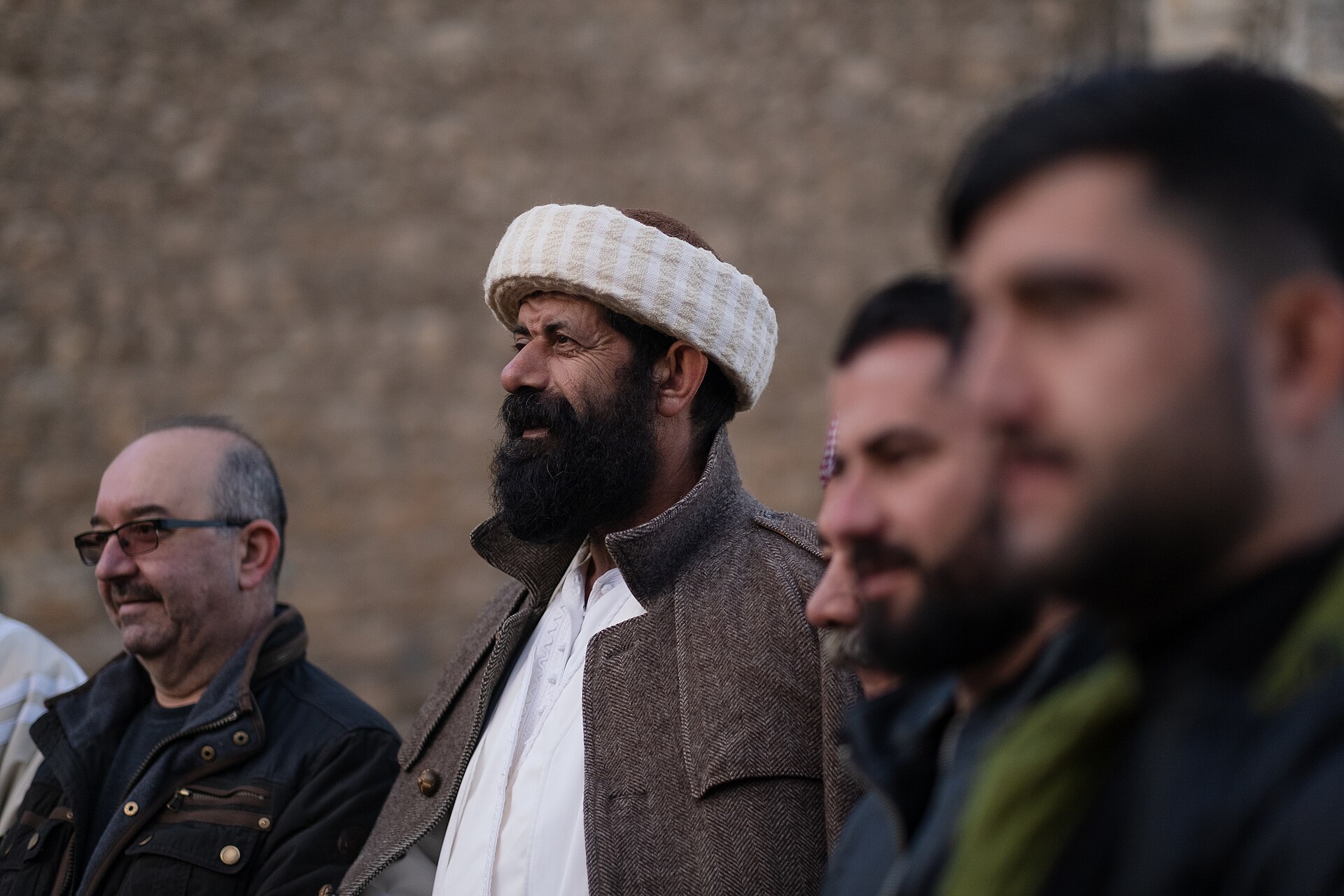
Yazidism is an oral religion. Nothing is written down, so there is not much to argue over. What makes it distinctive is mainly found in habits, not doctrine.
365 lamps of Lalish
Every evening wicks are lit across the sanctuary, using olive oil pressed in the valley itself. One flame for every day of the year. The families who tend them pass the job from parent to child.
Barefoot pilgrimage
Every Yazidi should reach Lalish at least once in their life. You go in barefoot, and you step over – never on - the sanctuary’s thresholds. Inside hang knotted cloths: every knot holds the wish of a stranger, and by untying one you release someone else's wish and tie your own.
The sun and Wednesday
Yazidis pray facing the sun, in the morning and in the evening. Wednesday is the holy day. In April they celebrate Red Wednesday, which they keep as the birthday of the world, with dyed eggs and torchlight.
Caste and rebirth
Society is divided into three groups that do not intermarry. Sheikhs and pirs are the two priestly castes, and murids are everybody else, meaning the great majority. Souls are believed to return in new bodies, so the community keeps renewing itself across lifetimes. That also explains why leaving the faith feels like leaving your family.
3 August 2014
Sinjar
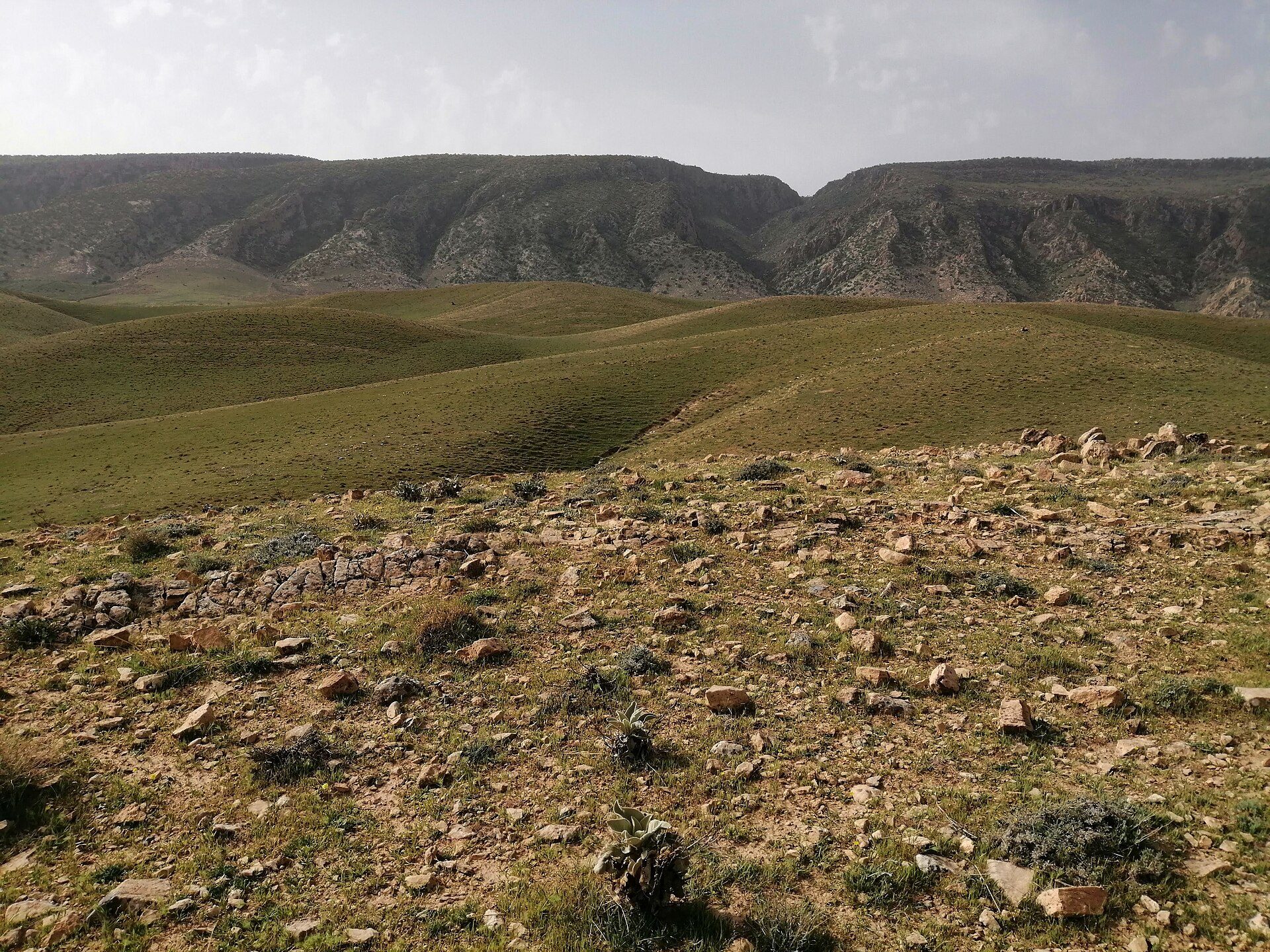
On 3 August 2014 ISIS overran the Sinjar district in a single day. The men were killed. The women and girls were taken as slaves. Tens of thousands fled up Mount Sinjar without water, in the August heat, and were surrounded at the top. Relief did come, from an odd coalition. American aircraft dropped food and water from the night of 7 August, alongside Iraqi, British and Australian planes, and began striking ISIS positions a day later. What actually got people off the mountain was a corridor fought open from the Syrian side by the YPGYPG The People's Protection Units, the Kurdish militia that became the core of the armed forces of north-east Syria. and the PKKPKK The Kurdistan Workers' Party, the Kurdish guerrilla movement founded in Turkey in 1978 and based in the Qandil mountains of northern Iraq.Encyclopaedia Britannica. View source ↗, who walked and drove tens of thousands out through Syria and back into Iraq. The Peshmerga guarding Sinjar had withdrawn before the attack, and Yazidis have not forgotten either fact.
Roughly 5,000 Yazidis were killed and more than 6,000 women and children abducted. Some 2,700 are still missing.
Radical Islamists consider Yazidis devil-worshippers. ISIS showed at least some restraint towards Christians, who could convert, pay a tax or leave. However, the Yazidis got the full portion of islamists’ brutality. The United Nations and a long list of parliaments have since recognised the campaign as genocide. In the community's own count it was the seventy-fourth.
Most of Sinjar's Yazidis are still living in displacement camps in the Iraqi Kurdistan Region. The town itself is contested between armed factions and reconstruction has barely started. In 2018 Nadia Murad received the Nobel Peace Prize for her testimony. She survived the massacre at Kocho, and she was the first Iraqi ever to win the prize.
Seventy-four times, our elders say, someone has tried to end us.The firmans — the counted persecutions of Yazidi memory
Geography
Where they live
Based on work by Dr. M. Izady, Atlas of the Islamic World and Vicinity (New York: Columbia Univ, 2006–present) @ gulf2000.columbia.edu/maps.shtml
Through time
Timeline
- 12th centurySheikh Adi settles at Lalish. The Sufi mystic's teaching fuses with older Iranian tradition; his tomb becomes the faith's holiest place.
- 16th–19th c.The firmans. Successive Ottoman and tribal campaigns against the “devil-worshipper” slander devastate Yazidi districts; community memory counts 72 persecutions before the modern era.
- 2007The Qahtaniya bombings. Four coordinated truck bombs kill nearly 800 Yazidis near Sinjar — one of the deadliest terrorist attacks in history.
- 3 Aug 2014The Sinjar genocide. ISIS kills ~5,000, enslaves thousands of women and children, and displaces the entire district.
- 2018Nadia Murad wins the Nobel Peace Prize for her advocacy for survivors of sexual violence in war.
- TodayAn uncertain return. Some 200,000 remain displaced; Germany hosts the largest diaspora, and Lalish still lights its lamps every evening.
Where Yazidis live
Estimated population
Estimates from community organisations and minority-rights reporting, 2020s. The diaspora — Germany above all, plus older communities in Armenia, Georgia and Russia — now approaches the homeland in size.
What they gave the region
Keepers of the oldest songbook
Because the religion is oral, everything rests on the qewwals. These are the reciter-musicians who carry the sacred texts in their heads, working with a frame drum and a flute, and the role passes down through a small number of families. What they carry is one of the oldest unbroken sacred repertoires in the region. Musicologists now study it as one of the few surviving records of Mesopotamian religious song.
Yazidi shrines have also given northern Iraq one of its most recognisable silhouettes, with those fluted conical spires. And the spring festival, with its dyed eggs and its new fire, keeps alive rites a good deal older than the community carrying them.
Then there is what the Yazidis have given the region simply by remembering. Nadia Murad's testimony turned the catastrophe of one small community into the clearest genocide case in modern international law. Every other minority in Iraq now has the words to demand the same.
Looking forward
Return, or a homeland in Germany?
Everything depends on Sinjar. If the town is ever rebuilt and demilitarised, the Yazidis have a homeland again. If not, the centre of gravity keeps shifting to Germany. Some 200,000 Yazidis live there now, building temples and archives and a public life they never had at home.
Lalish and the Baba Sheikh still hold the religion together. The Baba Sheikh is the community's senior spiritual figure, roughly the equivalent of a patriarch. There have also been careful reforms. Women who survived ISIS captivity are now welcomed back into the community, which under the old purity rules would have been unthinkable.
Nobody knows how this ends. Birth rates are high and the young generation is well organised. The sanctuary has already outlived seventy-four attempts to finish it off, on the community's own count, and that count is a religious tradition as much as a historical record.
The emblem
The spire of Lalish
For the Yazidis the emblem is the fluted cone of Lalish. Twelve ridges of sun-baked stone rising to a gilded tip, which is said to catch the first ray of the morning sun. The spire turns up wherever Yazidis build, including in Germany.
Sources11
- Philip G. Kreyenbroek, Yezidism: its background, observances and textual tradition (Edwin Mellen Press), 1995.
- Encyclopaedia Britannica, Yazidi. britannica.com
- Philip G. Kreyenbroek and Khalil Jindy Rashow, God and Sheikh Adi are perfect: sacred poems and religious narratives from the Yezidi tradition (Harrassowitz), 2005.
- Birgül Açıkyıldız, The Yezidis: the history of a community, culture and religion (I.B. Tauris), 2010.
- UN Human Rights Council, “They Came to Destroy”: ISIS Crimes Against the Yazidis, 2016. ohchr.org
- Minority Rights Group, Yezidis in Iraq – community profile. minorityrights.org
- Valeria Cetorelli and others, Mortality and kidnapping estimates for the Yazidi population in the area of Mount Sinjar, Iraq, in August 2014 (PLOS Medicine), 2017. journals.plos.org
- The Nobel Foundation, Nadia Murad – Nobel Peace Prize 2018, 2018. nobelprize.org
- Nadia Murad, The last girl: my story of captivity and my fight against the Islamic State (Tim Duggan Books), 2017.
- Christine Allison, The Yezidi oral tradition in Iraqi Kurdistan (Routledge), 2001.
- Zentralrat der Êzîden in Deutschland, community estimates.